Your Closet Knows Things You Haven’t Said Out Loud
What your wardrobe is really holding — and what it might be time to let go
Here’s something I’ve noticed in nearly every closet I’ve ever worked in. There’s always a section that doesn’t quite belong to today. A dress from a different chapter. A blazer from the job that changed everything. A soft sweater that came out every time life got hard. Pieces that haven’t been worn in years — but that somehow feel completely impossible to give away.
Table of Contents
When a client hesitates over something like that, I never push. Because I know what’s really happening. It’s not about the garment. It was never about the garment. Your closet is a timeline. And every piece in it is carrying something.
Why Getting Dressed Can Feel So Emotional
Most of us think of a wardrobe as a practical thing — clothes for work, clothes for weekends, things that fit, things that don’t. A problem to organize and solve.
But spend enough time in this work and you realize: a wardrobe is one of the most emotionally honest spaces a person owns.
It holds the blazer from your first real job interview. The dress you wore when you felt most like yourself. The university-era pieces that still sit in the back, soft with nostalgia. The clothes that arrived after a loss, quieter and more protective than anything you’d worn before. The things you bought during a hopeful season — and the things you bought to survive a hard one.
Without even meaning to, most women don’t just organize their closets around function. They organize them around identity.
The Section of Your Wardrobe That Belongs to Someone Else
I want to talk about what I call the “past self” section — and almost every client has one.
It’s not the stuff you wear. It’s the stuff you keep.
Maybe it’s from a time you felt more confident, more free, more visible, or simply more like the version of yourself you liked best. Maybe it’s waiting for a body, a lifestyle, or a life you’re still hoping to return to. Maybe it just feels deeply wrong to let it go — like releasing it means closing a door you’re not ready to close.
This is why clearing out a wardrobe can feel like grief. Because sometimes it genuinely is.
The attachment isn’t about the fabric. It’s about what the fabric represents — a chapter, a feeling, a version of yourself that mattered. And identity transitions are complicated. They don’t always come with clean endings.
But here’s what I’ve seen over and over again: the women who hold onto everything rarely feel more connected to those chapters. They just feel more crowded. Surrounded by ghosts of former selves, unable to clearly see who they are right now.
A meaningful wardrobe makes space for memory and for becoming. Those two things can coexist — but only when you’re honest about which is which.
Dressing to Feel Safe
There’s another thing that happens in wardrobes that nobody talks about enough.
We don’t just dress for the world around us. We dress to manage the world within us.
Think about what you reach for on an anxious morning. A hard week. A day when everything feels uncertain. Chances are it’s something familiar — a soft fabric, an oversized silhouette, a go-to formula you could put together in the dark. That’s not laziness or lack of imagination. That’s your nervous system asking for something predictable in a moment that doesn’t feel that way.
Comfort dressing is psychological. It’s real. And it’s worth understanding.
Oversized pieces can feel protective — like emotional armor that doesn’t look like armor. Soft fabrics provide sensory reassurance when everything else feels rough. Structured tailoring can restore a sense of control when life is pulling in too many directions. Even the act of wearing the same thing repeatedly can reduce the small but cumulative stress of too many decisions.
Color works this way too. Neutrals create quiet. Black grounds and protects. A burst of color can pull you back into your own energy when you’ve gone flat. Soft tones can feel like rest.
None of this is superficial. It’s one of the most human things we do — reaching for what makes us feel held when we need it.
The Pieces You Can’t Let Go Of
Some garments cross over into something deeper than comfort. They become almost impossible to release — not because they’re useful, but because they’re symbolic.
A wedding dress. A piece of inherited jewelry. The first outfit you wore when you finally felt like yourself. Clothing from someone no longer here.
These aren’t just things. They’re emotionally inhabited. They hold belonging, love, achievement, identity, continuity — the moments when something shifted and you recognized yourself differently.
There is nothing wrong with keeping pieces like that. Sentimental clothing is meaningful. Some things should stay.
The question I always ask my clients is: are you keeping this with intention — or from fear?
Because there’s a difference between preserving what’s deeply meaningful and surrounding yourself entirely with emotional remnants of former selves. One honors your story. The other keeps you stuck in it.
A wardrobe doesn’t need to erase memory. It just needs to have room for now.
What Your Wardrobe Is Trying to Tell You
Here’s the thing about personal style that most people miss: it’s almost always ahead of us.
A woman starts gravitating toward a different color palette before she can explain why. She begins buying softer pieces, or more structured ones, or things that feel bolder than her usual — and only later realizes she was already moving toward a new version of herself. The wardrobe sensed it first.
Reinvention almost always shows up in the closet before it shows up in words.
Which means that when you feel disconnected from your clothes — when nothing feels right, when the closet feels full but somehow empty — that’s not a styling problem. That’s an identity signal. Something in you is shifting, and your wardrobe hasn’t caught up yet.
The most grounding wardrobes I’ve helped build aren’t the most curated or the most expensive. They’re the ones that are emotionally honest — that reflect who the person actually is today, while leaving space for who she’s becoming.
Not every chapter has to stay hanging in the closet to still be meaningful.
Sometimes the most powerful thing you can do is release something with gratitude instead of guilt — and finally make room for what comes next.
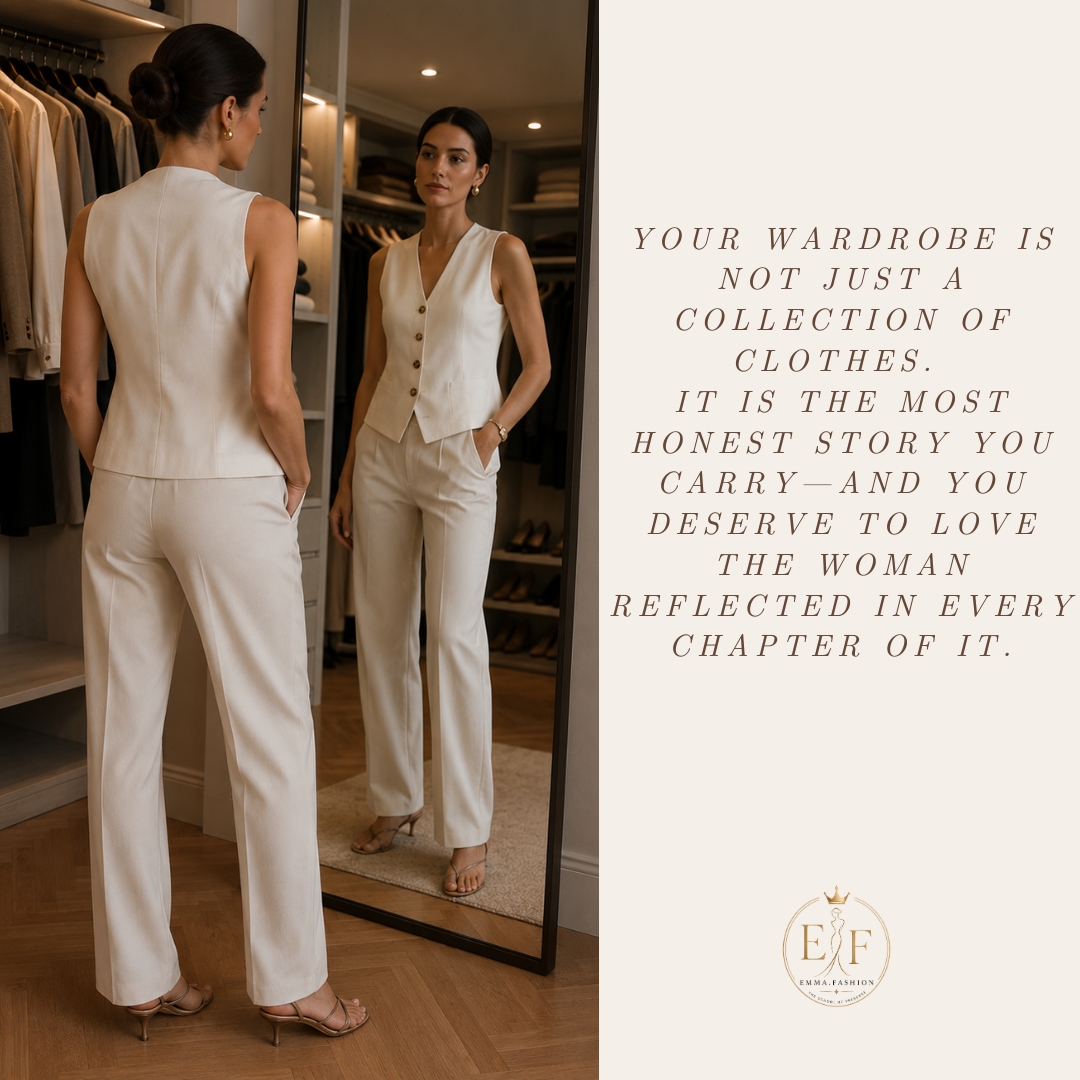
Because your wardrobe isn’t just clothes. It’s the most honest story you own. And you deserve to love every chapter that’s currently in it.
Frequently Asked Questions
Why do some clothes feel impossible to let go of?
Because clothing often carries emotional meaning. A garment may represent a memory, identity, relationship, achievement, or life chapter rather than simply being something to wear.
What is a “past self” closet?
A past self closet is the part of your wardrobe filled with clothing connected to who you used to be, who you miss being, or who you once hoped to become.
Is comfort dressing a bad thing?
No. Comfort dressing can be a healthy form of emotional regulation, especially during stressful or uncertain seasons.
How do I know if I am keeping clothing from fear?
If a piece creates guilt, pressure, or emotional heaviness rather than meaning, it may be held from fear rather than intention.
How can I build a wardrobe that reflects who I am now?
Begin by noticing what feels aligned, useful, emotionally supportive, and true to your current life. Release pieces that belong only to guilt, fantasy, or outdated identity.
Work With Emma.Fashion
If you want to understand what your wardrobe is really holding, refine your personal image, and create a closet that reflects who you are now, Emma.Fashion offers guidance rooted in presence, emotional clarity, and intentional style.
Discover how to build a wardrobe that feels aligned, honest, and beautifully current.


Comments