Comfort Dressing in Summer: Psychology or Practicality?
Most people believe they dress more casually in summer simply because temperatures rise. And while that is certainly true, it is only part of the story.
Table of Contents
- What Does Comfort Dressing Really Mean?
- How Summer Changes Our Relationship with Clothing
- The Psychology of Feeling Comfortable
- Comfort Dressing as Emotional Regulation
- Why We Reach for Certain Pieces Every Summer
- When Comfort Becomes Avoidance
- Elegance and Comfort Can Coexist
- Presence Is the Missing Ingredient
- Reflection
- Frequently Asked Questions
- Work With Emma.Fashion
Summer changes not only the climate around us but also our emotional landscape. We begin to crave freedom, ease, movement, and lightness. The layers of winter disappear, our days stretch longer, and our routines soften. Almost without noticing, our wardrobes begin to reflect those inner shifts.
What we often call comfort dressing is therefore much more than a practical response to warm weather. It becomes a reflection of how we want to feel. The clothing we choose during summer quietly reveals our relationship with confidence, authenticity, identity, and emotional well-being.
True comfort dressing lives at the intersection of practicality and psychology.
What Does Comfort Dressing Really Mean?
Comfort is often described in physical terms. We think of breathable fabrics, lighter clothing, relaxed silhouettes, and garments that allow us to regulate body temperature more easily. These practical choices are essential during warm weather, but they tell only half the story.
Comfort also has a psychological dimension.
Psychological comfort may come from feeling emotionally safe, wearing familiar silhouettes, moving without restriction, trusting that our clothing fits well, and feeling authentic rather than self-conscious.
When both forms of comfort come together, dressing becomes effortless. The body feels at ease, and the mind is no longer distracted by discomfort or insecurity.
Comfort is experienced by both the body and the mind.
How Summer Changes Our Relationship with Clothing
Every season influences our wardrobe, but summer changes our behavior in unique ways. Longer daylight hours encourage us to spend more time outdoors. Vacations interrupt routines. Social gatherings become more frequent. Parks, cafés, beaches, and city streets become extensions of everyday life.
These environmental changes create psychological ones.
Summer naturally encourages openness, spontaneity, experimentation, and a sense of freedom. We become more willing to explore new experiences, and our clothing often reflects that emotional expansion.
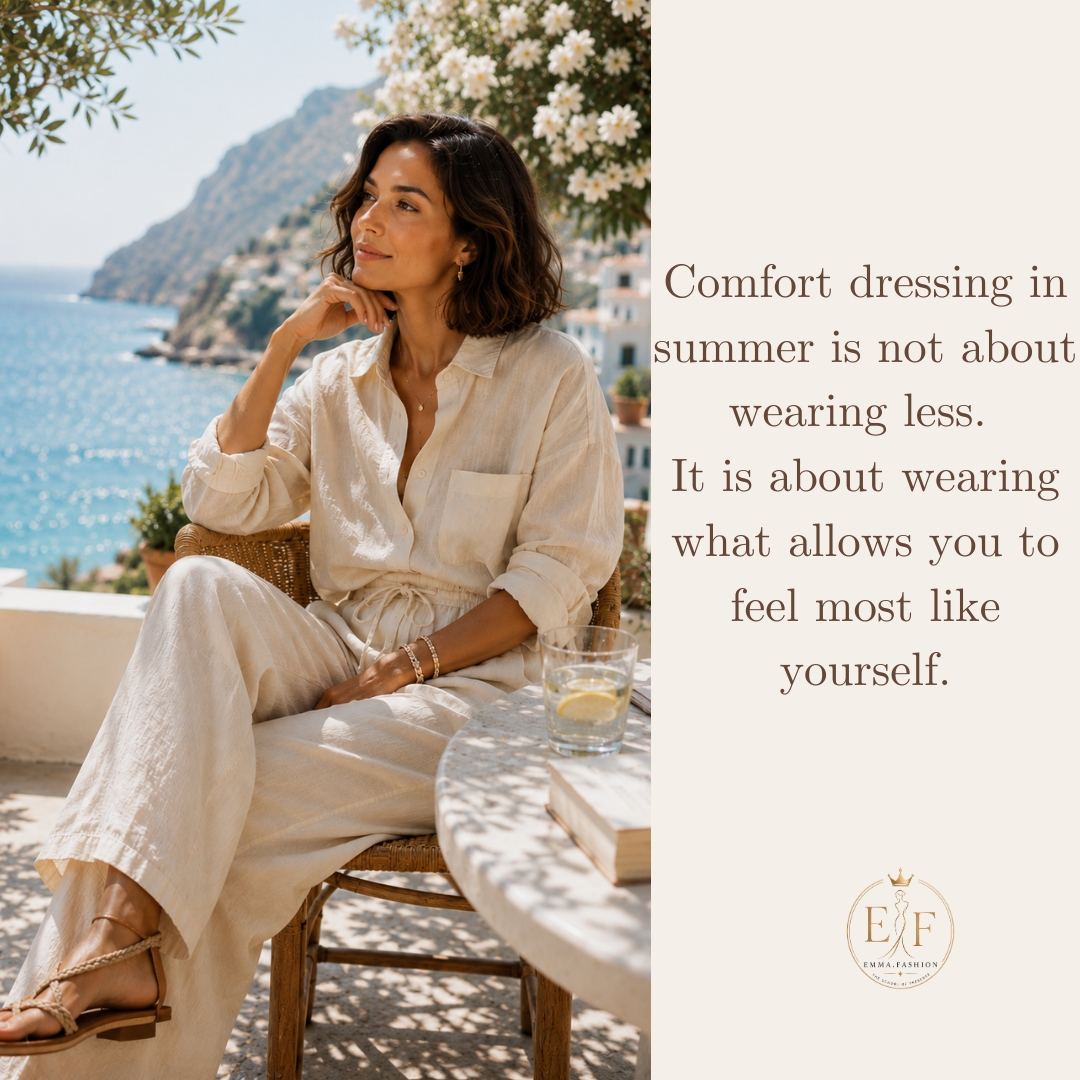
Flowing dresses replace structured jackets. Linen replaces heavier fabrics. Sandals replace closed shoes. The wardrobe becomes lighter because, psychologically, we are seeking lightness.
Style follows emotion long before it follows trends.
The Psychology of Feeling Comfortable
Comfort dressing is sometimes misunderstood as simply wearing oversized clothing. Yet true psychological comfort is rarely defined by size alone.
It often comes from:
- Feeling authentic.
- Wearing silhouettes that feel familiar.
- Knowing that clothing fits well.
- Moving easily throughout the day.
- Feeling socially appropriate.
- Feeling attractive without trying too hard.
There is a quiet confidence that comes from clothing that allows us to stop thinking about ourselves and start engaging with the world around us.
Sometimes we are not seeking comfort from clothing. We are seeking comfort from ourselves.
When clothing supports rather than distracts us, it creates the conditions for presence.
Comfort Dressing as Emotional Regulation
Clothing has always helped us regulate emotion, often without our conscious awareness.
After stressful workdays, we instinctively change into softer clothing. During periods of burnout, uncertainty, travel, or major life transitions, familiar garments often become emotional anchors.
Comfort dressing can provide:
- A sense of security.
- Predictability.
- Emotional grounding.
- Gentle self-soothing.
Soft fabrics often create reassurance through touch. Structured garments can create emotional stability by restoring a sense of order and confidence.
Neither approach is better. Each responds to a different psychological need.
Understanding this helps us become more intentional about what we wear, rather than assuming our choices are purely practical.
Why We Reach for Certain Pieces Every Summer
Most of us have a summer uniform, whether we realize it or not.
Perhaps it is the linen shirt you wear every weekend. A flowing white dress that always feels right. Wide-leg trousers that move effortlessly in the breeze. A favorite pair of sunglasses that instantly changes how you carry yourself.
These pieces become more than seasonal clothing. They become psychological anchors.
They remind us of holidays, family gatherings, walks along the coast, evenings with friends, or simply versions of ourselves that felt relaxed and confident.
Our recurring summer favorites often represent:
- Ease.
- Confidence.
- Identity.
- Positive memories.
- Freedom.
What we call a “summer wardrobe” is often a collection of garments associated with emotional well-being.
When Comfort Becomes Avoidance
There is another side to comfort dressing that deserves attention.
Sometimes comfort is no longer about ease. It becomes protection.
Oversized clothing may become a way of hiding body insecurity rather than expressing personal style. Neutral colors may become a way of avoiding visibility rather than reflecting genuine preference. Loose silhouettes may gradually shift from freedom to emotional camouflage.
The distinction matters.
Comfort supports presence. Avoidance reduces it.
The goal is never to force ourselves into uncomfortable clothing. It is to notice whether our choices are helping us participate more fully in life—or encouraging us to disappear from it.
Elegance and Comfort Can Coexist
Many people still carry an outdated belief that elegance requires discomfort.
That polished clothing must feel restrictive. That comfortable clothing cannot also be refined.
Modern dressing proves otherwise.
Beautiful linen tailoring, flowing midi dresses, well-cut wide-leg trousers, natural fabrics, and thoughtfully designed sandals demonstrate that elegance and comfort are not opposites.
In fact, comfort often allows elegance to feel more authentic.
When clothing supports movement, confidence, and ease, elegance becomes something we embody rather than perform.
Presence Is the Missing Ingredient
Comfort alone does not create style.
Fashion alone does not create confidence.
Presence connects both.
When we feel physically comfortable, we become mentally available. We listen more closely. We engage more fully. We notice the people around us instead of constantly adjusting ourselves.
Presence grows naturally when clothing supports rather than competes with our attention.
Style then becomes an extension of well-being instead of performance.
The most memorable summer outfits are rarely the most elaborate. They are the ones worn by someone who feels completely at ease within herself.
Reflection
Think about the pieces you return to every summer.
Do they simply feel comfortable? Or do they remind you of the version of yourself who feels most alive?
Perhaps the clothing you love most is revealing something deeper than your taste. Perhaps it is revealing where you feel most like yourself.
Summer reminds us that comfort is not merely about escaping the heat.
It is about creating enough ease that we can fully inhabit both the season—and ourselves.
The most memorable summer style is rarely the most elaborate.
It is the one that allows us to move with confidence, breathe with ease, and show up with presence.
Because comfort dressing is never only practical.
At its best, it is deeply psychological.
Frequently Asked Questions
What is comfort dressing?
Comfort dressing is the practice of choosing clothing that supports both physical ease and psychological well-being. It combines breathable fabrics and relaxed silhouettes with confidence, familiarity, and authenticity.
Why do people dress more casually in summer?
Warm weather encourages lighter fabrics and relaxed silhouettes, but summer also creates psychological associations with freedom, leisure, and openness, which naturally influence personal style.
Can comfortable clothing still look elegant?
Absolutely. Linen tailoring, flowing dresses, well-cut trousers, and quality natural fabrics demonstrate that comfort and elegance can coexist beautifully.
Can clothing influence emotional well-being?
Yes. Clothing often helps regulate emotion by providing familiarity, confidence, and a sense of security. What we wear can influence how we feel throughout the day.
How do I know if I’m dressing for comfort or avoidance?
If your clothing helps you feel present, confident, and engaged, it supports comfort. If it consistently helps you hide or withdraw from visibility, it may be functioning as emotional protection instead.
Work With Emma.Fashion
Your wardrobe should support more than your appearance—it should support the way you experience yourself every day. If you’re ready to build a wardrobe that reflects your personality, lifestyle, and presence with greater clarity and intention, Emma.Fashion offers personal styling and image consulting designed around who you are, not simply what is trending.
Contact Emma.Fashion to discover how thoughtful style can become an extension of confidence, comfort, and authentic self-expression.

Comments