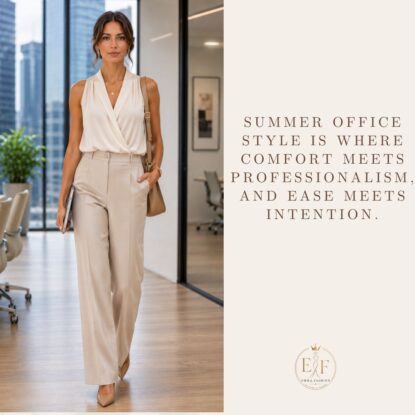
Summer at the Office: How to Stay Cool Without Losing Your Edge
A stylist’s honest guide to dressing professionally when the temperature refuses to cooperate
Let me tell you what I see every summer without fail. Women who dress impeccably all year long suddenly standing in front of their closet in June looking completely lost. The clothes that worked in March feel wrong. The urge to be comfortable is real. And somewhere between “I can’t wear that, it’s too hot” and “I can’t wear that, it’s too casual” — the whole thing becomes genuinely stressful.
Table of Contents
Summer office dressing is one of the most common topics I get asked about. And I understand why. The season creates a real tension: your body wants comfort, your workplace still expects professionalism, and the fashion world is full of beautiful things that belong firmly on a terrace in the South of France — not in a Tuesday morning meeting. Here’s what I tell every client who comes to me with this exact problem: summer doesn’t suspend the rules. It just requires you to apply them more thoughtfully.
The New Rules of Summer Office Style
Summer Doesn’t Cancel Professionalism
This is the first thing to get clear on — and it sounds obvious until you look around most offices in July.
Warmer weather has a way of making people feel like the standards have quietly relaxed. They haven’t. What has changed is the way you meet those standards. The goal isn’t to look like you’re trying as hard as you do in winter. The goal is to look like you’re not trying at all — and still arrive looking pulled-together, intentional, and appropriate.
There’s a crucial distinction between relaxed and casual. Relaxed is a linen-blend trouser in place of wool. Casual is showing up in whatever you’d wear to run errands on a Saturday. One communicates ease and awareness. The other communicates that you stopped paying attention.
Your industry matters here too. A creative studio operates differently from a law firm. A client-facing role carries different expectations than working independently. Know your environment — and dress just slightly above it, even in summer.
Dress for the Whole Day, Not Just the Walk In
This is something most people don’t think about until they’re freezing at 11am after dressing for the 85-degree commute.
Summer office dressing requires a bit of strategy. The outside world is warm. The inside world — with its aggressively air-conditioned open-plan offices — can feel like a different season entirely. A great summer office outfit accounts for both.
Layering is your best tool here. A sleeveless shell top works beautifully under a lightweight blazer you can remove. A cardigan draped over your chair costs you nothing but saves the day by 3pm. Think of your outfit as something that transitions — not just something that looks good at 8am when you leave the house.
What to Actually Wear
Fabrics That Do the Work for You
The foundation of great summer office dressing is fabric choice. Get this right and everything else becomes easier.
Linen blends are the summer workhorse — breathable and beautiful, but always choose a blend over pure linen if you want to stay presentable past your morning coffee. Pure linen creases aggressively; a linen-cotton or linen-viscose blend moves with you.
Cotton poplin is crisp, polished, and genuinely comfortable in heat. A well-fitted poplin shirt is one of the most professional things you can wear in summer — full stop.
Lightweight wool sounds counterintuitive, but it is genuinely remarkable. Fine merino or tropical wool regulates temperature, holds its shape all day, and reads as impeccably professional. It’s a quiet power move.
Structured jersey gives you the comfort of a softer fabric without sacrificing polish. Look for pieces with enough weight to drape properly rather than cling.
The rule I give every client: choose fabrics that hold their shape while allowing airflow. If it looks wrecked by lunchtime, it doesn’t belong at the office.
Tops That Mean Business
Summer office tops are where I see the most confusion — and the most easily avoidable mistakes.
A crisp white shirt is the single most reliable piece in your summer office wardrobe. Fitted through the shoulder, open at the collar if you like, rolled sleeves when appropriate. It never fails.
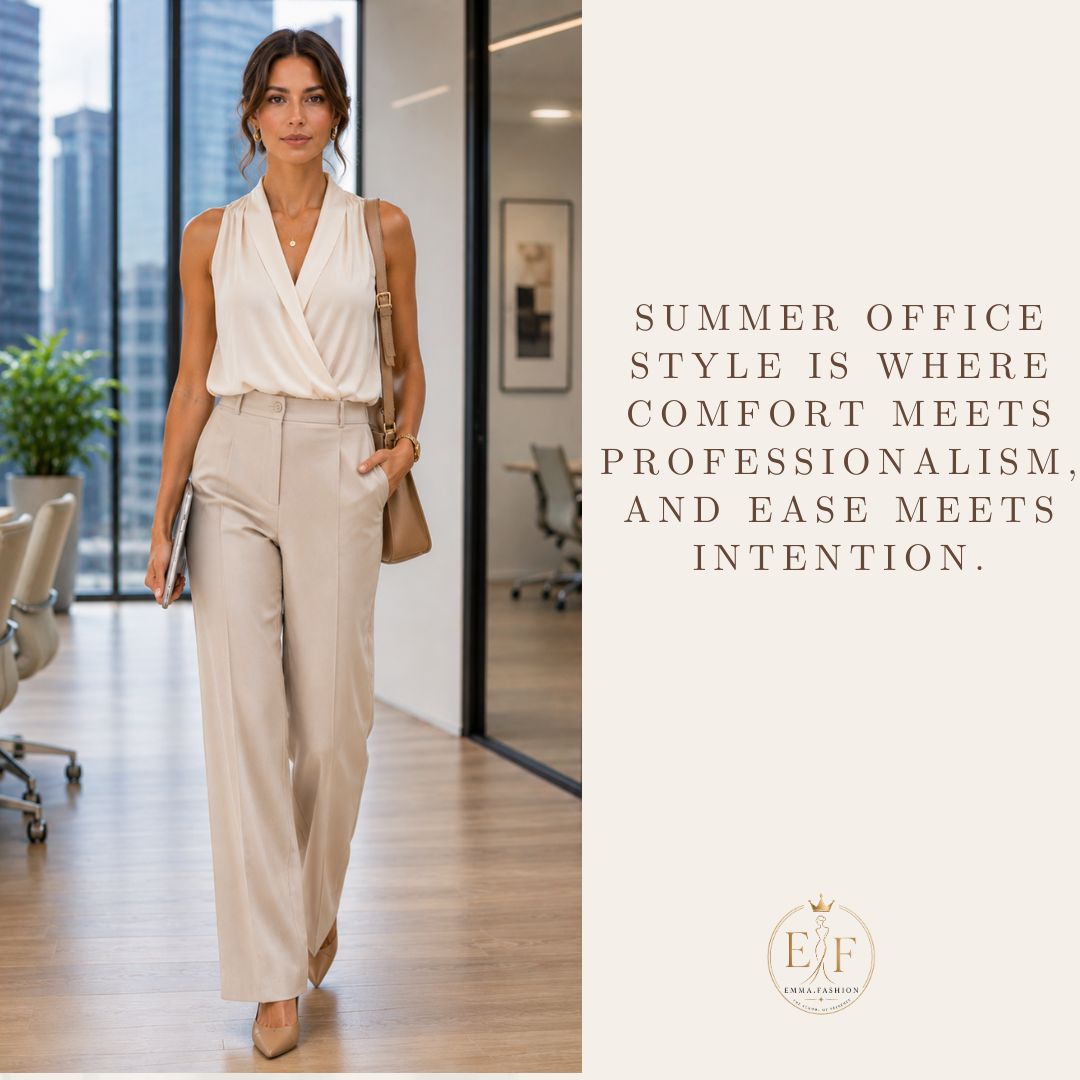
Sleeveless shell tops are perfectly professional when they’re well-fitted, have an appropriate neckline, and are made in a fabric with some structure. Pair with trousers or a midi skirt and you’re done.
Boatneck and scarf-neck blouses are quietly elegant — they add visual interest without tipping into anything that reads as too casual or too dramatic for a professional setting.
Refined knit tops in fine gauge work beautifully in air-conditioned environments and bridge the gap between relaxed and polished.
The thing to keep in mind with all of these: neckline awareness matters. You can absolutely be feminine and professional simultaneously. It’s about balance, not suppression. A beautiful top that’s appropriate is infinitely more powerful than one you spend the day second-guessing.
Bottoms That Look Good and Let You Breathe
This is where summer dressing can genuinely get comfortable without sacrificing anything.
Wide-leg trousers in a lightweight fabric are, in my opinion, the perfect summer office bottom. They’re cool, they move beautifully, and they look intentional. Pair with a tucked-in shell and a heel or loafer and the whole thing is effortless.
Tailored ankle pants offer a slightly more structured option — great if your office skews more conservative, and the cropped length actually helps in heat.
Midi skirts and A-line skirts are wonderful in summer: feminine, comfortable, and when chosen in the right fabric and fit, absolutely office-appropriate. Keep the print controlled and the fabric structured enough to hold shape.
Culottes get a bad reputation they don’t deserve. In a quality fabric and a proper fit, they’re one of the most practical and stylish summer office options available.
Whatever you choose — tailoring still matters. A beautiful fabric in a silhouette that doesn’t quite fit is still a miss. Summer is not an excuse for shapelessness.
Dresses That Work at a Desk
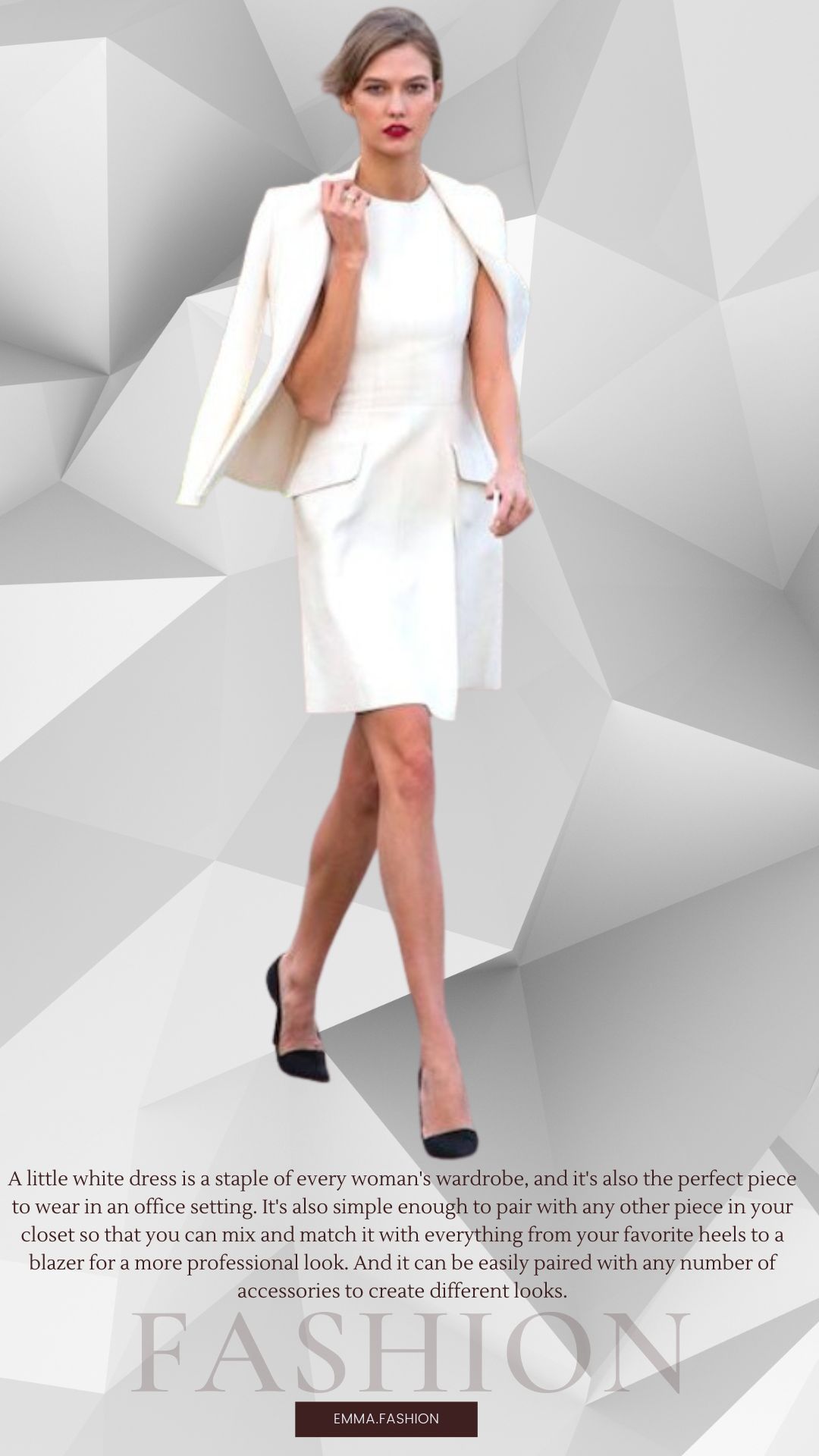
A single, well-chosen dress is the most efficient summer office outfit there is. One piece, zero coordination, completely put-together.
Shirt dresses are reliably professional — add a belt and structured bag and they immediately look intentional. Wrap dresses are flattering on most bodies and translate beautifully into office environments in the right print and length. Sheath dresses and structured midi dresses offer the cleanest, most polished option if your office is more formal.
Length matters here. A midi length — hitting anywhere from the knee to mid-calf — is the safest and often the most elegant choice for office summer dressing. Mini lengths require a very specific, confident environment to work professionally, and anything that reads as beachwear simply doesn’t belong at a desk, no matter how warm it is.
Fit should be comfortable but considered. A dress that’s too loose loses all its shape; one that’s too fitted in summer heat creates its own problems. Aim for something that moves with you.
Footwear That Finishes the Look
Summer office footwear is where a lot of otherwise polished outfits quietly fall apart.
Slingbacks are one of the most elegant warm-weather office shoes available — a small heel, a clean silhouette, endlessly versatile. Loafers are equally reliable and far more comfortable for longer days on your feet. Block heels offer height with stability, which matters more than people admit.
Elegant flats — think ballet flats, pointed-toe flats, or a refined mule — can absolutely work in most professional environments. The key word is refined. There’s a significant visual difference between a well-made leather flat and something that reads as casual footwear.
Open-toe sandals are industry-dependent. In creative, relaxed, or fashion-adjacent environments, a beautiful strappy sandal is completely appropriate. In more conservative professional settings, err toward closed or peep-toe styles. When in doubt, choose the more polished option and save the open sandal for a workplace you know well.
The Etiquette Nobody Talks About Enough
Style Is Awareness, Not Just Self-Expression
This is something I feel strongly about — and it applies year-round, but becomes especially relevant in summer when the temptation to prioritize comfort is at its strongest.
How you dress at work communicates something before you’ve said a word. It signals how you read the room, how seriously you take the environment, and how aware you are of the people around you. A client meeting, a presentation to leadership, a day when someone new is coming in — these all warrant a slightly more considered version of your summer office dressing, even if no one explicitly said so.
Hybrid work has made this more complex, not simpler. The days you choose to come in matter more now, and dressing as though they do is a form of professional intelligence.
Vacation Style Versus Office Style
Summer brings out a particular category of mistake I see regularly — vacation dressing that found its way into the office.
There is a version of summer style that belongs entirely on holiday: raffia bags, beach sandals, cover-up silhouettes, bold resort prints, anything with a drawstring waist. Beautiful. Appropriate in the right context. Completely wrong at a desk.
The office version of summer is similar in spirit but different in execution. A structured tote instead of a straw bag. A refined sandal instead of a beach slide. A tailored silhouette in a lightweight fabric instead of something that billows freely. A print that’s interesting but contained rather than tropical and loud.
The distinction is intentionality. Both can feel light and summery. Only one of them communicates that you’re at work.
The Showing Skin Question
This comes up constantly and the answer is always the same: it’s about balance, not rules.
You don’t need to cover up entirely in summer. Sleeveless tops are fine in most professional environments. A midi dress with a slightly open neckline is beautiful. A well-chosen hemline above the knee can work depending on your industry and environment.
What to be more careful about: very deep necklines that become distracting, extremely short hems that require constant adjustment, sheer fabrics worn without proper layering underneath, and anything that genuinely reads as lingerie-adjacent.
The question I always ask: would I feel confident and undistracted in this all day? If the answer is yes — wear it.
The Mistakes Worth Avoiding
- Dressing for the beach instead of the building. Flip-flops, beach dresses, anything designed for a poolside — these have no place at a desk, regardless of how warm it is. If you wouldn’t wear it to a professional meeting, it doesn’t belong in the office.
- Overcompensating with casual. Summer casualness sometimes becomes an excuse for things that were never quite appropriate: distressed denim, athletic wear, oversized graphic tees. Relaxed and casual are not the same. One is ease with intention. The other is simply not dressing for where you are.
- Choosing fabrics that wrinkle into chaos. Pure linen, certain rayons, unwashed cotton — these can look beautiful at 9am and disastrous by noon. How you look at the end of the day matters as much as how you look at the beginning. Choose fabrics that hold up.
- Wearing clothing that’s too revealing for the environment. This is never really about the clothing itself — it’s about calibrating to your specific workplace. Know the culture. Dress just above it.
- Losing all shape and structure. Summer dressing can sometimes drift into oversized, shapeless, formless territory in the name of comfort. But proportion and intentionality still matter. A wide-leg trouser needs a fitted top. A flowy dress benefits from a belt. Structure doesn’t mean restrictive — it means considered.
Five Outfit Formulas That Actually Work
When in doubt, come back to these. They work for nearly every summer office environment.
- Formula 1: White poplin shirt + wide-leg trousers + loafers. The summer office classic. Never fails.
- Formula 2: Sleeveless shell top + midi skirt + elegant sandals. Feminine, cool, and entirely professional.
- Formula 3: Shirt dress + belt + structured handbag. One piece, zero effort, completely pulled-together.
- Formula 4: Scarf-neck blouse + tailored culottes + slingbacks. A little more interesting, just as polished.
- Formula 5: Lightweight blazer + shell top + ankle trousers. For the days when the air conditioning is merciless or the meetings are serious.
The Point of All of It
The most elegant summer office wardrobes do something quietly impressive.
They acknowledge the season without using it as an excuse. They feel lighter and easier without becoming careless. They understand that dressing appropriately isn’t about following rigid rules — it’s about respect. For the moment you’re in, the environment around you, and the people you’re showing up for.
Because dressing well at work in summer isn’t really about staying cool.
It’s about showing up with the same presence and intentionality you bring the rest of the year — just with better fabric and slightly more air between you and your clothes.
And honestly? That’s a skill worth having.
Frequently Asked Questions
What should I wear to the office in summer?
Choose breathable but polished pieces such as linen-blend trousers, cotton poplin shirts, sleeveless shell tops, shirt dresses, midi skirts, and refined flats or slingbacks.
Are sleeveless tops appropriate for the office?
In many professional environments, yes. The key is choosing a structured fabric, an appropriate neckline, and a fit that feels polished rather than casual.
Can I wear sandals to work in summer?
It depends on your workplace. Creative or relaxed environments may allow refined open-toe sandals, while conservative offices usually call for closed-toe or peep-toe styles.
How do I look professional when it is very hot outside?
Focus on breathable fabrics that hold their shape, light layering for air-conditioned spaces, and silhouettes that feel comfortable but still considered.
What is the biggest mistake in summer office dressing?
The biggest mistake is confusing relaxed with casual. Summer dressing can feel lighter and easier, but it should still communicate professionalism and awareness.
Work With Emma.Fashion
If you want to refine your professional wardrobe, develop a summer office style that feels polished and comfortable, or build a personal image that communicates presence with ease, Emma.Fashion offers guidance rooted in clarity, intention, and modern elegance.
Discover how to dress for the season without losing your edge.


Comments