Summer Style and Presence: The Difference Between Being Dressed and Being Remembered
We have all seen someone beautifully dressed and forgotten the details shortly afterward. And we have all encountered someone whose presence stayed with us, even when we could not remember exactly what she wore.
Table of Contents
- Being Dressed Is Visible. Presence Is Experienced.
- Why Summer Makes This Difference More Visible
- When the Outfit Is Perfect but Still Feels Disconnected
- Presence Begins with Congruence
- The Psychology of Being Remembered
- The Same Dress, Different Presence
- Summer Elegance Is Often About Ease
- Presence Is Not a Performance
- What Makes Summer Style Memorable?
- From Being Seen to Being Remembered
- Frequently Asked Questions
- Work With Emma.Fashion
Perhaps she wore a simple linen dress. Perhaps a white shirt with relaxed trousers. Perhaps nothing particularly dramatic at all. Yet something remained: the way she moved, the ease in her posture, the warmth in her expression, the confidence that did not ask for attention.
This raises an important question: what makes one woman simply well dressed, while another becomes memorable?
Summer offers a beautiful lens through which to explore this difference. The season naturally removes excess. There are fewer layers, softer structures, simpler combinations, and less visual architecture to hide behind. When clothing becomes quieter, presence often becomes easier to see.
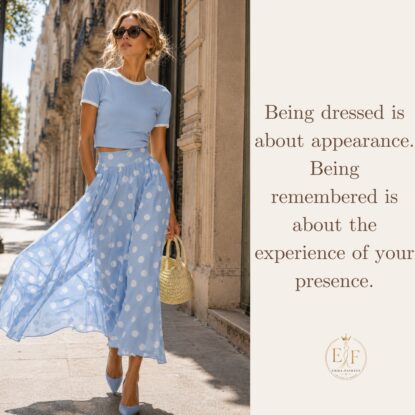
Being dressed is about appearance. Being remembered is about the experience of your presence.
Being Dressed Is Visible. Presence Is Experienced.
Being dressed refers to the visible composition of an image. It includes clothing, color, fit, proportion, accessories, grooming, and styling. These elements matter. They shape first impressions, communicate intention, and influence how others perceive us before we speak.
But presence includes something less tangible.
Presence is energy. Posture. Self-possession. Emotional tone. Attentiveness. Confidence. It is the way a woman enters a space, listens, responds, and allows others to feel in her company.
A person can be impeccably dressed and still appear disconnected from herself. Another can wear something remarkably simple and seem completely compelling.
The difference is often not the outfit.
It is congruence.
Style is what the eye notices. Presence is what the person experiences.
Why Summer Makes This Difference More Visible
Winter allows us to build identity through layers. Coats, scarves, boots, textures, structure, and rich fabrics can create an entire visual story before the person beneath them is fully revealed.
Summer simplifies everything.
A dress. A shirt. A pair of trousers. Sandals. Perhaps one meaningful accessory.
With fewer layers, the relationship between the woman and her clothing becomes more important. The body is more visible. Posture becomes more noticeable. Movement becomes part of the image. Comfort—or discomfort—can be read more easily.
Summer asks for ease, but ease cannot be faked. A woman who feels uncomfortable in what she wears often communicates that tension through small gestures: adjusting a strap, pulling at fabric, checking herself too often, or moving with guarded awareness.
When clothing becomes simpler, the way a woman inhabits the clothing becomes the true point of distinction.
When the Outfit Is Perfect but Still Feels Disconnected
A woman may wear the right trend, the right color, the right designer piece, the right sandals, and the right accessories—and still feel unlike herself.
The outfit may be visually successful, but psychologically wrong.
This internal tension often becomes visible. Movement becomes restricted. Posture becomes self-conscious. The attention remains focused inward. Instead of living inside the moment, the woman is managing the outfit.
This is why beauty alone does not always create presence.
An outfit can look polished and still feel like a costume. It can photograph beautifully and still fail to support the woman wearing it. It can be admired by others and still feel disconnected from identity.
The most beautiful outfit cannot create presence when the woman inside it feels absent from herself.
Presence Begins with Congruence
Congruence is the alignment between who you are, how you see yourself, how you dress, how you behave, and how others experience you.
When these elements support one another, style feels natural rather than performed.
This is why a woman in a simple white linen dress may appear more compelling than someone in a highly styled, trend-driven outfit. The first woman may feel comfortable, grounded, expressive, at ease, and connected to herself. Nothing feels forced.
People often interpret congruence as confidence.
Not because the person is louder.
Not because the clothing is more dramatic.
But because there is no visible conflict between the woman and the image she presents.
Presence begins when the outside reflects the inside with honesty and refinement.
The Psychology of Being Remembered
People rarely remember every visual detail of an encounter. They may forget the exact dress, the earrings, the shade of lipstick, or the handbag.
But they often remember how they felt around someone.
They remember whether the interaction felt warm. Whether they felt seen. Whether the person seemed grounded. Whether her confidence felt calm or demanding. Whether something about her felt distinctive.
A beautiful outfit may attract attention.
But presence creates association.
This is the deeper psychology of being remembered. Memory is not built only from visual impact. It is often tied to emotional experience.
We remember not only what we saw, but what we experienced in someone’s company.
The Same Dress, Different Presence
Imagine two women wearing the same summer dress.
Same color. Same silhouette. Same fabric.
One woman enters the room while constantly adjusting the dress. She checks how others are looking at her. Her posture becomes guarded. Her attention remains focused on herself.
The second woman enters wearing the same dress. She moves naturally. She listens when others speak. She smiles without performing. She appears comfortable in her own space.
The dress has not changed.
The presence has.
This example reminds us that clothing does not operate independently from the person wearing it. The same garment can create two entirely different impressions because presence changes the meaning of what we see.
The dress may introduce the image, but the woman gives it life.
Summer Elegance Is Often About Ease
Summer elegance does not require excessive styling, perfect coordination, expensive clothing, or constant formality.
It may appear through a relaxed silhouette, thoughtful grooming, natural movement, appropriate dressing, simplicity, and self-possession.
But ease should not be mistaken for carelessness.
Ease is the result of alignment. It appears when clothing supports the body, suits the environment, reflects the personality, and allows the woman to move through the day without constant self-monitoring.
A simple linen dress can feel elegant when it is well chosen and worn with quiet confidence. A white shirt can feel memorable when paired with natural posture and attentive energy. A pair of sandals can feel refined when the whole look is considered.
Perhaps the most elegant woman in the room is not the one wearing the most remarkable outfit, but the one who seems most fully at home in herself.
Presence Is Not a Performance
Presence is often misunderstood as charisma, extroversion, dominance, or the ability to command a room.
But presence can be quiet.
A woman can be reserved and deeply present. She can speak softly and still be memorable. She can wear simple clothing and still create distinction.
Presence is not about occupying more space than others. It is about being fully connected to the space you already occupy.
It appears in the way someone listens. In the calmness of her gestures. In the steadiness of her eye contact. In the lack of urgency to prove herself.
Presence is not something added to style after the outfit is complete.
It is what allows style to become meaningful.
What Makes Summer Style Memorable?
Memorable summer style often includes visible elements: a recognizable color palette, a consistent silhouette, one signature detail, thoughtful simplicity, clothing that supports natural movement, accessories that feel personal rather than decorative, and grooming that feels intentional.
But these elements become memorable only when they are connected to identity.
A scarf becomes memorable because she always wears it beautifully.
A particular shade of blue becomes recognizable because it feels connected to her.
A simple dress becomes distinctive because of the way she carries herself.
Recognition is built when style becomes an extension of identity rather than a collection of isolated outfits.
This is why the most memorable women are rarely the ones who change themselves completely with every trend. They may evolve, but there is a thread of continuity. Something about their appearance, energy, and behavior feels coherent over time.
That coherence becomes part of how they are remembered.
From Being Seen to Being Remembered
Being seen may depend on color, novelty, trends, and visual impact. These elements can capture attention quickly.
Being remembered depends on something deeper: consistency, authenticity, emotional impression, distinction, and presence.
The goal is not to reject beautiful clothing. Clothing matters. It shapes perception. It communicates intention. It introduces us before we speak.
But clothing is the beginning of the experience, not the whole experience.
Your image may introduce you. Your presence determines what remains.
What Remains After the Outfit Is Forgotten
At the end of summer, we may forget many of the outfits we saw.
We may forget the exact dress, the sandals, the handbag, or the carefully chosen accessories.
But we often remember the woman who seemed completely herself.
The one who listened.
The one who moved with ease.
The one whose confidence did not need to announce itself.
The one whose elegance felt natural rather than arranged.
Perhaps this is the deeper difference between being dressed and being remembered.
Being dressed creates an image.
Presence creates an experience.
And long after the details of an outfit disappear from memory, the feeling of someone’s presence can remain.
Style may introduce you. Presence is what remains in the room.
Frequently Asked Questions
What is the difference between style and presence?
Style is the visible expression of clothing, color, fit, grooming, and accessories. Presence is the emotional experience someone creates through energy, posture, confidence, attentiveness, and self-possession.
Can someone be well dressed but not memorable?
Yes. A person can wear a beautiful outfit and still feel disconnected from herself. Being memorable often depends less on visual perfection and more on congruence, ease, and emotional impression.
Why does summer make presence more visible?
Summer simplifies clothing. With fewer layers and less structure, posture, movement, comfort, and self-possession become more noticeable.
What makes summer style elegant?
Summer style feels elegant when ease is paired with intention. Simple silhouettes, thoughtful grooming, appropriate dressing, natural movement, and confidence create refinement without excess.
How can I become more memorable through style?
Build consistency around colors, silhouettes, details, and grooming that reflect your identity. Then focus on how you inhabit what you wear—your posture, ease, attentiveness, and presence.
Work With Emma.Fashion
If you want to refine your personal image, develop a wardrobe that feels aligned with who you are, and create a presence that is remembered beyond the outfit, Emma.Fashion offers personal image guidance rooted in clarity, elegance, and authenticity.
Style is not only about being seen. It is about becoming recognizable, coherent, and deeply connected to how you wish to be experienced.


Comments